
Full list of publications can be found on Google Scholar, arXiv, ORCID and Inspire.
The Pulsars we measure: Selection Effects in the Neutron star mass distribution
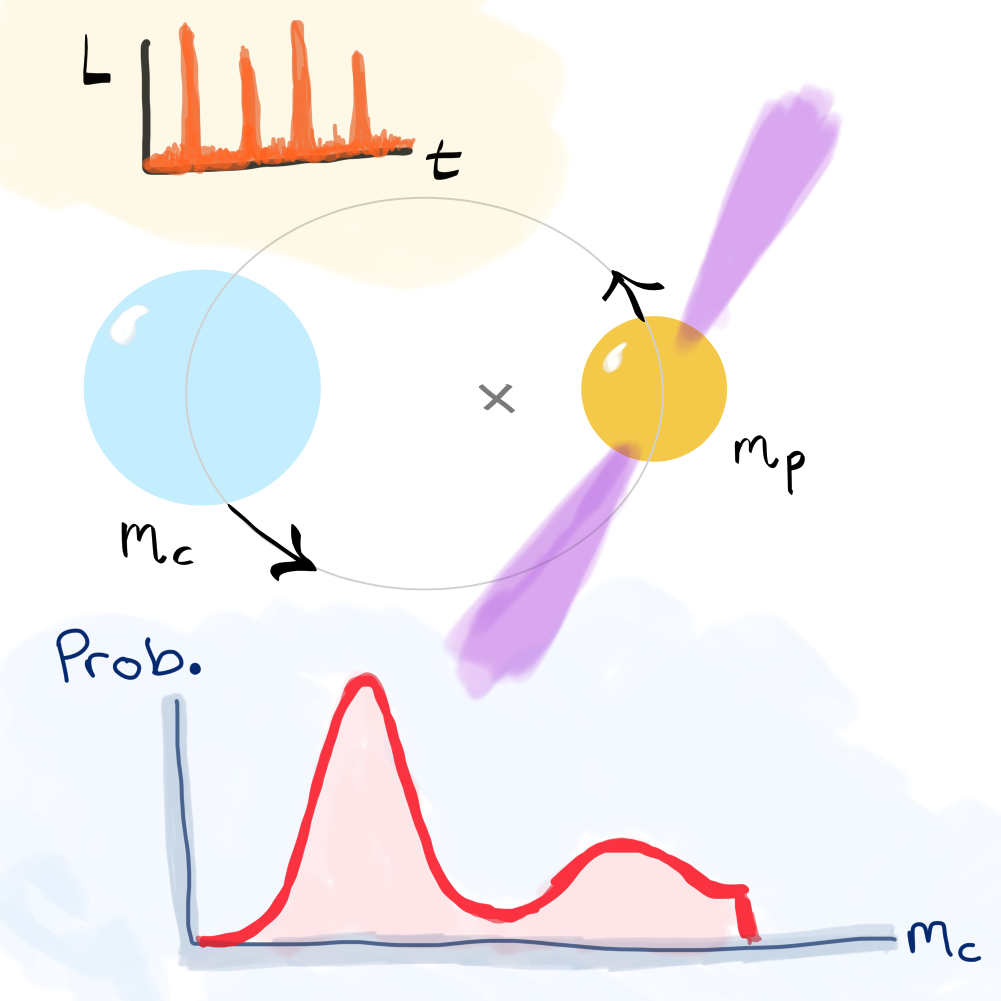
In our paper arXiv:2609.03157, we investigate how selection effects impact the neutron star mass distribution measured through radio timing. We model which binary pulsars are detectable and which allow precise mass measurements; then we assess how these effects shape the population we observe. Click for more details.
The masses of Galactic pulsars in binaries measured through radio timing point to structure in the mass distribution with implications for dense matter and astrophysical formation processes. However, this observed population of radio pulsars is shaped not only by intrinsic pulsar properties, such as birth masses, binary evolutionary pathways and dense-matter constraints, but also by observational effects. In existing catalogs of pulsar mass measurements, observational selection effects influence (i) which systems are detected in the first place (detectability) and (ii) which systems yield well-measured masses (measurability). In this work, we revisit the radio pulsar population distribution in the context of observational effects associated with pulsar radio timing. Simulating systems of radio pulsars and timing observations, we track the process by which a given system ends up in an observational dataset and estimate the impact of the binary and pulsar parameters. We fold this selection function into hierarchical population inference and extract the intrinsic astrophysical distribution of pulsars observed with radio timing. We jointly infer the populations of pulsar mass, companion mass, orbital eccentricity, orbital period and pulsar spin period.
Cosmic Clocks around massive black holes: Probing Black holes with QPE timings
Cosmic Clocks around Massive Black Holes: What We Can Learn from QPE Timings
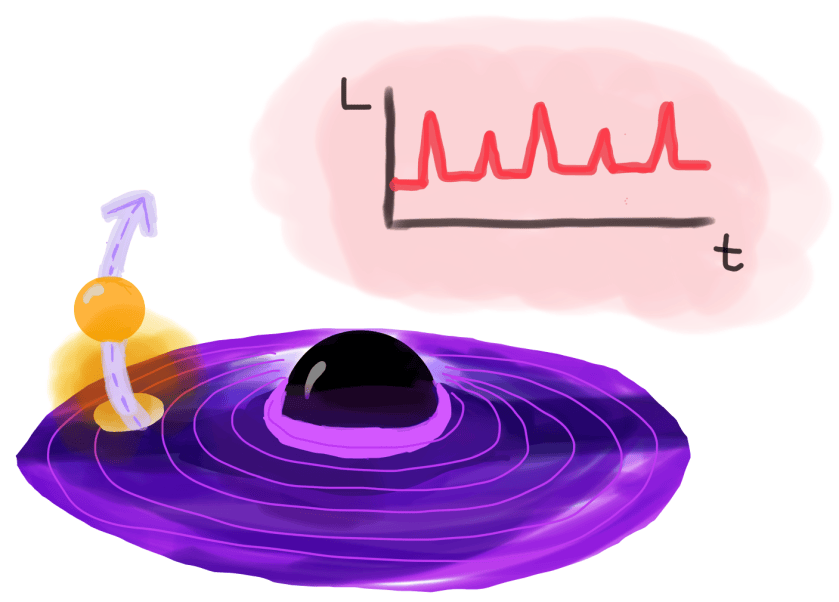
In our paper arXiv:2508.20162, we investigate how the timings of quasi-periodic eruptions (known as QPEs) can be used to measure the properties of the massive black hole at the center of the system. We show that QPE timings can constrain the black hole mass and spin. Click for more details.
EMRI scenarios offer a robust framework for interpreting QPEs by characterizing observational signatures associated with the secondary’s orbital dynamics. This, in turn, enables extraction of the massive black hole (MBH) properties and provides a means to test the EMRI scenario, distinguishing models and addressing the question: what can QPE timings teach us about massive black holes and EMRIs? In this study, we employ analytic expressions for Kerr geodesics to efficiently resolve the trajectory of the secondary object and perform GPU-accelerated Bayesian inference to assess the information content of QPE timings. Using our inference framework, referred to as QPE-FIT (Fast Inference with Timing), we explore QPE timing constraints on astrophysical parameters, such as EMRI orbital parameters and MBH mass/spin. We find that mild-eccentricity EMRIs (e ∼ 0.1 − 0.3) can constrain MBH mass and EMRI semimajor axis/eccentricity to the 10% level within tens of orbital periods, while MBH spin is unconstrained for the explored semimajor axes ≥ 100Rg and monitoring baselines O(10 − 100) orbits. This work highlights the prospect of QPE observations as dynamical probes of galactic nuclei.
Gravitational Waves from Gyroscopes inspiraling into Gargantuan black holes
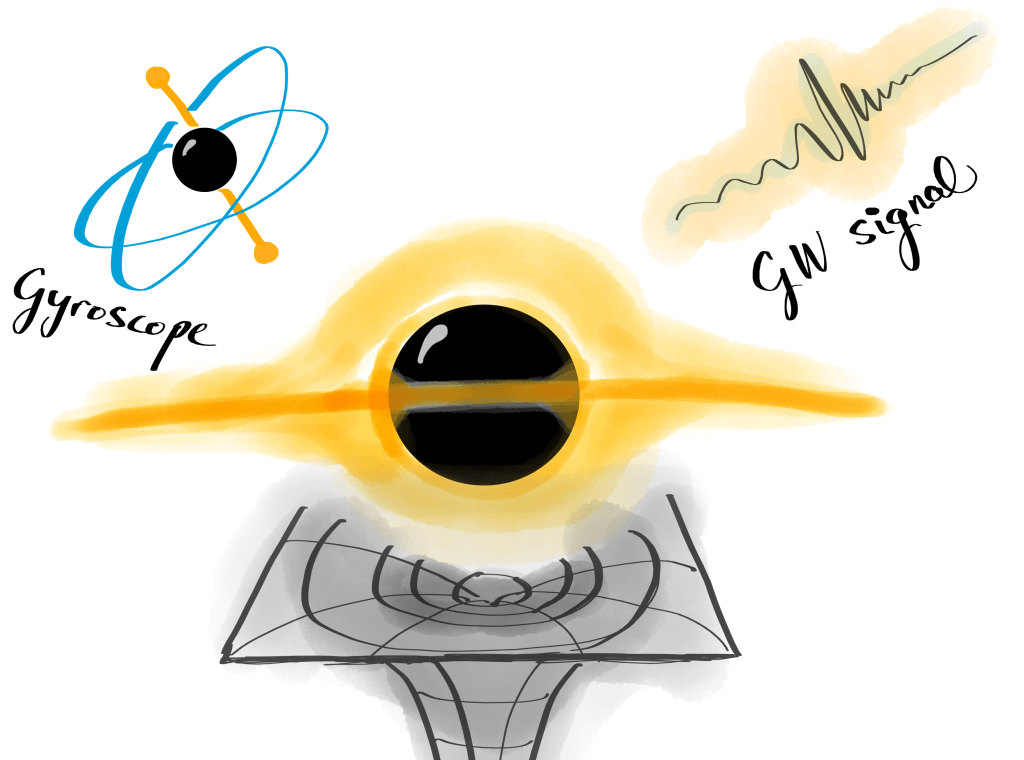
In our paper arXiv:2305.08919, we compute generic inspirals of spinning bodies and their associated waveforms (omitting several key aspects). We lay out a framework which we hope to serve as a foundation for including secondary spin effects in large-mass-ratio waveform models. Click for more details.
Extreme mass-ratio binary black hole systems are expected to radiate low-frequency gravitational waves detectable by planned space-based Laser Interferometer Space Antenna (LISA). We hope to use these systems to probe the spacetime in exquisite detail and make precision measurements of the larger black hole’s properties. Accurate models using general relativistic perturbation theory will allow us to realize the potential of these large mass-ratio systems. Such models must include post-geodesic corrections, including the backreaction due to gravitational-wave emission that leads to the inspiral of the small body into the black hole. When a spinning body orbits a black hole, its spin couples to the curvature of the background spacetime. This introduces a second post-geodesic correction called the spin-curvature force. In our paper arXiv:2305.08919, we calculate spinning-body inspirals and associated waveforms that include both spin-curvature forces and the leading gravitational wave backreaction. Aspects of the self force have been neglected, and these must be included in future work. We build a framework using an osculating geodesic formulation combined with a near-identity transformation to eliminate dependence on the orbital phases, allowing for very fast computation of completely generic worldlines.
Precisely computing orbits of spinning bodies around black holes
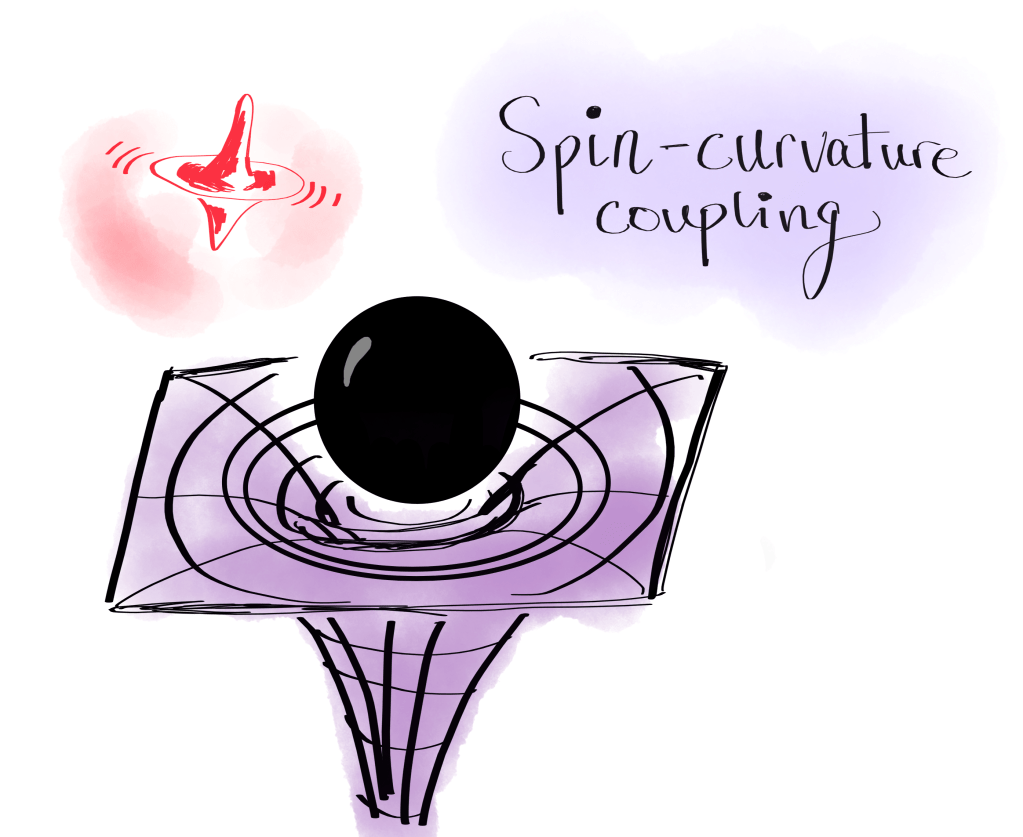
In our papers arXiv:2201.13334 and arXiv:2201.13335, we present a frequency-domain approach for precisely characterizing orbits of spinning bodies in the presence of spin-curvature coupling. Click for more details.
Post-geodesic effects such as spin-curvature coupling must be included in models of extreme mass-ratio binary black hole systems in order to build sufficiently accurate templates for LISA. Exploiting the fact that in the large mass-ratio limit spinning-body orbits are close to geodesics, we develop a frequency-domain formulation of the motion which can be solved precisely. We examine a range of orbits with this formulation. We investigate orbits which are eccentric and nearly equatorial but for which the small body’s spin is arbitrarily oriented (in DOI:10.1103/PhysRevD.105.124040, arXiv:2201.13334) and we also discuss generic orbits with general small-body spin orientation (in DOI:10.1103/PhysRevD.105.124041, arXiv:2201.13335). We characterize the behavior of these orbits and show how the small body’s spin shifts the frequencies which affect orbital motion. These frequency shifts change accumulated phases which are direct gravitational-wave observables, illustrating the importance of precisely characterizing these quantities for gravitational-wave observations.
Predicting pulsar glitches using a state-dependent Poisson process

In our paper, arXiv:1910.05503, we use a state-dependent Poisson process to model pulsar glitches, enabling us to predict the epoch of the next glitch for three different pulsars. Click for more details.
Glitches in some pulsars display power-law size and exponential waiting time distributions. These statistics are consistent with a state-dependent Poisson process, where the glitch rate is an increasing function of a global stress variable, which in this case is the angular velocity lag between the pulsar’s crust and the superfluid in its interior. In our paper (DOI:10.3847/1538-4357/ab44c3, arXiv:1910.05503), we estimate the parameters for this model for three pulsars (PSR J1740−3015, PSR J0534+2200, and PSR J0631+1036) and predict the epochs for each of their next glitches according to our model.
A Neutron star super-mixture of Interlinked vortex and flux tube arrays
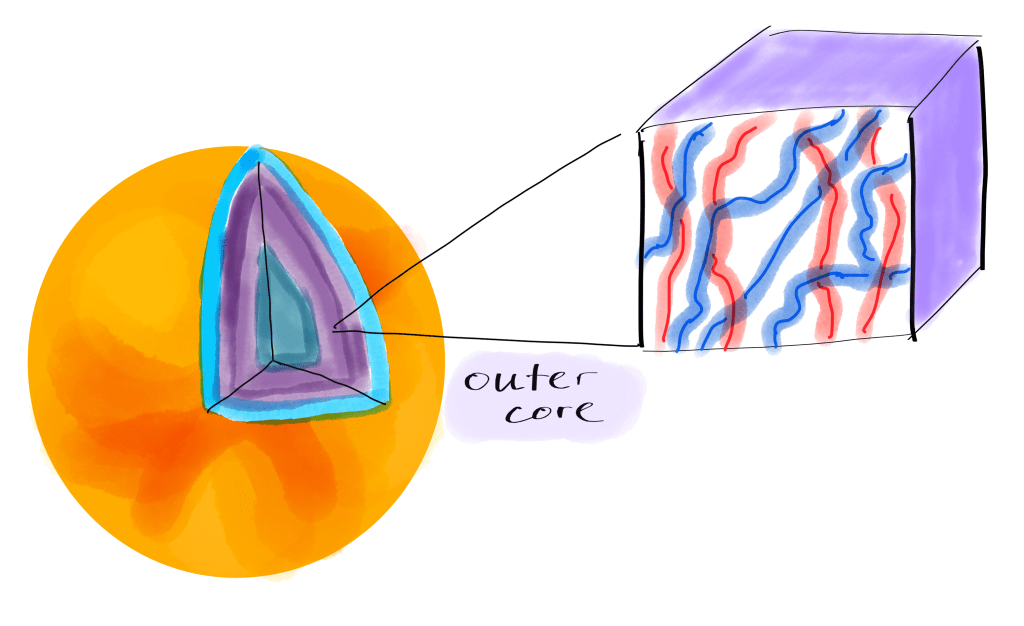
In our papers, arXiv:1709.02254 and arXiv:1712.02938 we investigate the tangling of interlinked superfluid vortex and superconducting flux tube arrays. Click for more details.
The outer core of a neutron star contains two interpenetrating fluids: superfluid neutrons and superconducting protons. The protons and rigid crust corotate, while the angular velocity of the neutrons is determined by the number and disposition of the superfluid vortices, each of which carries a quantum of circulation. The proton superconductor is type II, implying that the magnetic field is concentrated into flux tubes, each carrying a magnetic flux quantum. We investigate the complex microscopic interaction between neutron vortices and proton flux tubes in detail. We investigate the way in which the the vortex array rearranges and deforms geometrically in equilibrium (in DOI:10.1093/mnras/stx2301, arXiv:1709.02254) and under far-from-equilibrium conditions (in DOI:10.1093/mnras/stx3197, arXiv:1712.02938). For the idealized model presented in our papers, we find that an initially rectilinear vortex array bends macroscopically and tangles microscopically in certain regimes (forming a ‘vortex crystal’), challenging the conventional picture of the outer core of the neutron star.

